




Most trade show exhibitor manuals offer two ways to scan visitor badges: rent a scanner from the show's lead retrieval vendor, or license the show's lead retrieval app for your team's phones. Across five official 2026 order forms we checked, a rented scanner costs $399 to $685 per device where one is offered, and the first app license $299 to $525. Both fees cover one show only. Add extra users, custom questions, late-order surcharges and damage waivers, and a four-person booth team can easily spend more than $1,000 per show just to collect contact details.
This guide breaks down what each option really costs, using published 2026 exhibitor order forms (prices as of November 2026), shows where the extra fees hide, and explains how B2B sales and marketing teams can keep the scanning bill small without losing leads. We make Tapni, a digital business card and lead capture platform for teams that is part of Tapstack, so we also say plainly where a team platform helps and where you still need the show's own scanner.
The short answer
- Rented scanner: $399 to $685 per device, per show, on the forms we checked. You are liable for loss and damage, and one device serves one person at a time.
- The show's lead retrieval app: $299 to $525 for the first license, $145 to $179 for each extra user where a separate rate is listed, or $499 to $860 for a three-user package. For teams, it is usually cheaper than renting.
- Both are single-show purchases. Licenses are tied to devices, and at many shows the badge data is encrypted so only official equipment can read it.
- The number that matters is cost per qualified lead in your CRM, not cost per scanner. Leads that sit in an export file for two weeks are the most expensive ones you collect.
- A year-round team platform doesn't replace the official badge license where badges are encrypted, but it lets you buy fewer licenses and captures everyone your team meets away from the booth.
What you are actually choosing between
Lead retrieval is the organizer-approved way to turn a scanned badge into a lead record. Shows typically appoint one official vendor, who sells the hardware, the app and the badge data access to exhibitors. Here is how the three options compare.
| Option | How it works | How you pay | Watch out for |
|---|---|---|---|
| Rented badge scanner | The official vendor hands you a device loaded with the show's badge data. You return it at teardown. | Per device, per show | Loss and damage liability, late-return fees, one scanner per person |
| The show's lead retrieval app | You buy an activation code and scan badges with your own phones or tablets. | Per license (one device each) or per user package, per show | Prices step up after each deadline; phones must meet the app's requirements |
| Your own lead capture platform | Your team uses the same app at every event, meeting and sales visit, and leads flow into your CRM. | Per user, per year, whatever the number of shows | Encrypted badges need the organizer's developer kit to be read by outside tools |
That last point matters more than most buyers expect. The ASHP Midyear 2026 order form states that attendee badges are encrypted and can only be read by official lead retrieval equipment and the official app, and that outside equipment needs a developer's kit, priced at $1,350 to $1,500 for that show. SEMA Show 2026 sold an event API for $1,120 to $1,330, and the ASMBS 2026 Annual Meeting a developer API kit for $995. So "just use our own app" is rarely free if you want the registration data behind the barcode.
What lead retrieval costs in 2026: real order-form prices
These prices come from five official 2026 exhibitor order forms, as of November 2026. Each range runs from the earliest deadline to the late or on-site rate. Several of these shows have already taken place, so treat them as benchmarks rather than quotes, and check the exhibitor manual of the show you are planning.
| Show (2026) | App, first license | Each extra user | Three-user app package | Rented scanner | API or dev kit |
|---|---|---|---|---|---|
| SEMA Show | $455–$525 | $145 | $625–$685, custom qualifiers included | $605–$685 | $1,120–$1,330 |
| ASHP Midyear | $425–$485 | Another full license | $740–$860 | $495–$625 | $1,350–$1,500 |
| ASBO Annual Conference | $299–$359 | $149–$179 | $499–$599 | $459–$559 | Not listed |
| ASMBS Annual Meeting | $299 | Another full license | Not listed | $399 | $995 |
| Police Fleet Expo | $339 (early bird) | Another full license | Not listed | Not listed | Not listed |
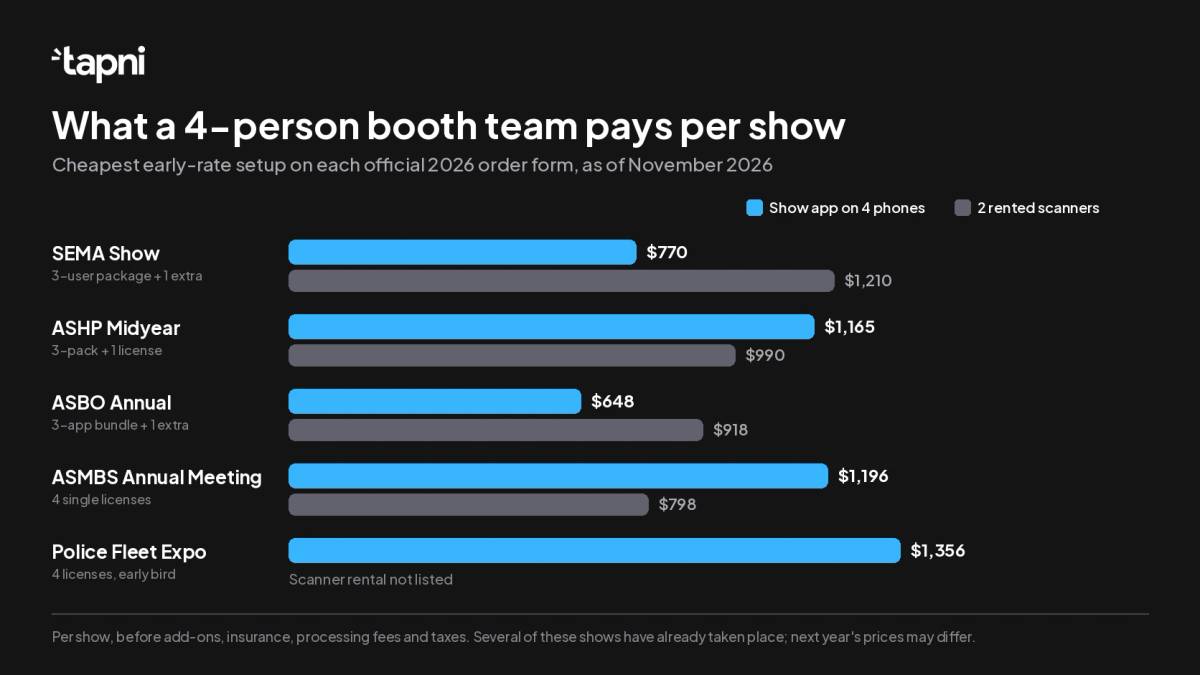
For a four-person booth team, the cheapest app setup at the early rate works out at $648 per show at ASBO (three-user bundle plus one activation), $770 at SEMA, $1,165 at ASHP Midyear, $1,196 at ASMBS and $1,356 at Police Fleet Expo. Renting two scanners instead would cost $798 to $1,210, and two scanners rarely keep four people busy at a crowded booth.
The fees that are not in the headline price
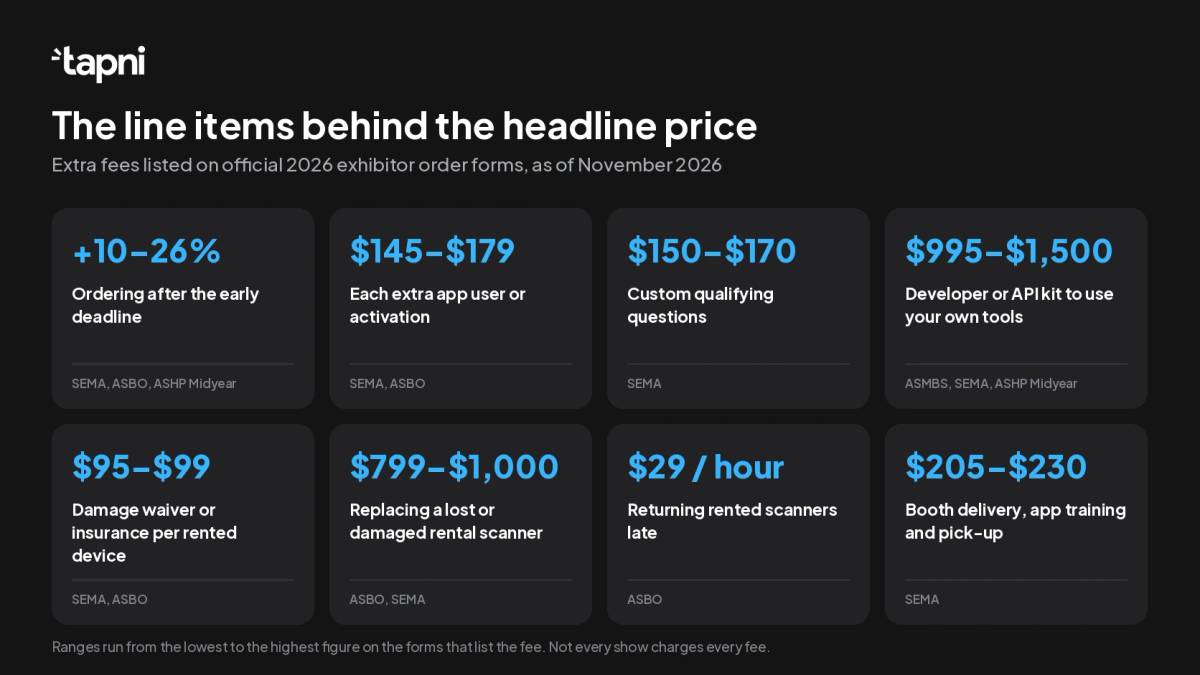
The license or rental price is the line everyone budgets for. These are the lines that push the final invoice well past it:
- Missing the early deadline. On the forms we checked, ordering late cost roughly 10% to 26% more. SEMA's app went from $455 to $525 after 22 September 2026, ASBO's scanner from $459 to $559, and the ASHP Midyear handheld from $495 early to $625 on site.
- Extra users. Licenses are tied to a device. ASHP Midyear and Police Fleet Expo state one device per license, while SEMA charges $145 and ASBO $149 to $179 for each extra activation.
- Custom qualifying questions. $150 to $170 at SEMA unless you buy the three-activation package, which includes them.
- Using your own system. API or dev kits cost $995 to $1,500 on the three forms that list one.
- Insurance and replacement. SEMA offered a $95 loss and damage waiver per rental item and listed $1,000 as the replacement cost of a rental device. ASBO offered $99 damaged device insurance and charges up to $799 for a lost scanner and $1,299 for a tablet.
- Late returns and admin. ASBO charges $29 per hour for scanners returned late, and SEMA adds a $25 processing fee ($10 less when you order online).
- Delivery and printers. SEMA listed booth delivery and training at $205 to $230 and a Bluetooth printer at $145 to $170.
Rental or app: which is cheaper for your team?
For one person, the app wins on every form that offers both: $455 against a $605 handheld at SEMA, $425 against $495 at ASHP Midyear, $299 against $459 at ASBO and $299 against a $399 device rental at ASMBS (early rates). For a team, user packages widen the gap, as long as everyone has a phone that meets the app's requirements. SEMA's app needed Android 13 or iOS 16.6 or later, and the ASHP Midyear app needed a device with an autofocus camera.
A rented handheld still makes sense in a few situations:
- Your reps' phones don't meet the app requirements, or company policy doesn't allow event apps on them.
- You run one fixed scanning station at a busy booth and want a dedicated device for it.
- The hall has weak connectivity. The ASHP Midyear handheld, for example, captures badges and notes without Wi-Fi.
If none of these apply, license the app for the people who actually scan, and don't buy a license for every person on the booth rota.
How to calculate your real cost per lead
Scanner prices are easy to compare, but they don't tell you whether a show paid off. Use this instead:
Cost per qualified lead = (licenses + rentals + add-ons + late fees) ÷ qualified leads that reached your CRM and got a follow-up
Here is an illustrative example using SEMA's early prices. Two rented handhelds ($1,210), the loss and damage waiver on each ($190) and the processing fee ($25) come to $1,425. If the booth scans 300 badges and 90 of those visitors are real prospects, the show cost $4.75 per scan but $15.83 per qualified lead. If a third of those 90 leads never get a follow-up because the export arrived late or sat in someone's inbox, each lead that was actually worked cost $23.75.
That is why the biggest savings usually come from speed rather than from cheaper hardware: qualify at the booth, tag every lead with the show name, and get the list into your CRM the same day. Our guide to capturing leads at trade shows covers the booth side in detail.
The year-round cost nobody puts in the event budget
Lead retrieval fees reset at every show. A four-person team doing six shows a year at the early per-show prices above would spend $3,888 to $8,136 on app licenses alone, or $4,788 to $7,260 on two rented scanners, before any add-ons. And none of that covers the conversations away from the booth: the session where a buyer sits next to your account executive, the partner dinner, the follow-up meeting the week after.
A team platform is priced the other way round. Tapni Business costs $59.90 per user per year for 1–10 users, with lower per-user prices from 11 users, and every seat includes a standard NFC card and Tapni PRO (as listed on our pricing page as of November 2026). For four people that is $239.60 a year, however many events you attend. Here is what it covers:
- Two-way contact exchange. A prospect taps your NFC card or scans your QR code and shares their details back from your profile in one tap, with no app needed on their side.
- AI scanner. The Tapni app captures details from paper business cards and event badges, so a rep without a show license can still log a visitor.
- Notes, tags and reminders. Tag the show, add the context and set a follow-up reminder before the conversation goes cold.
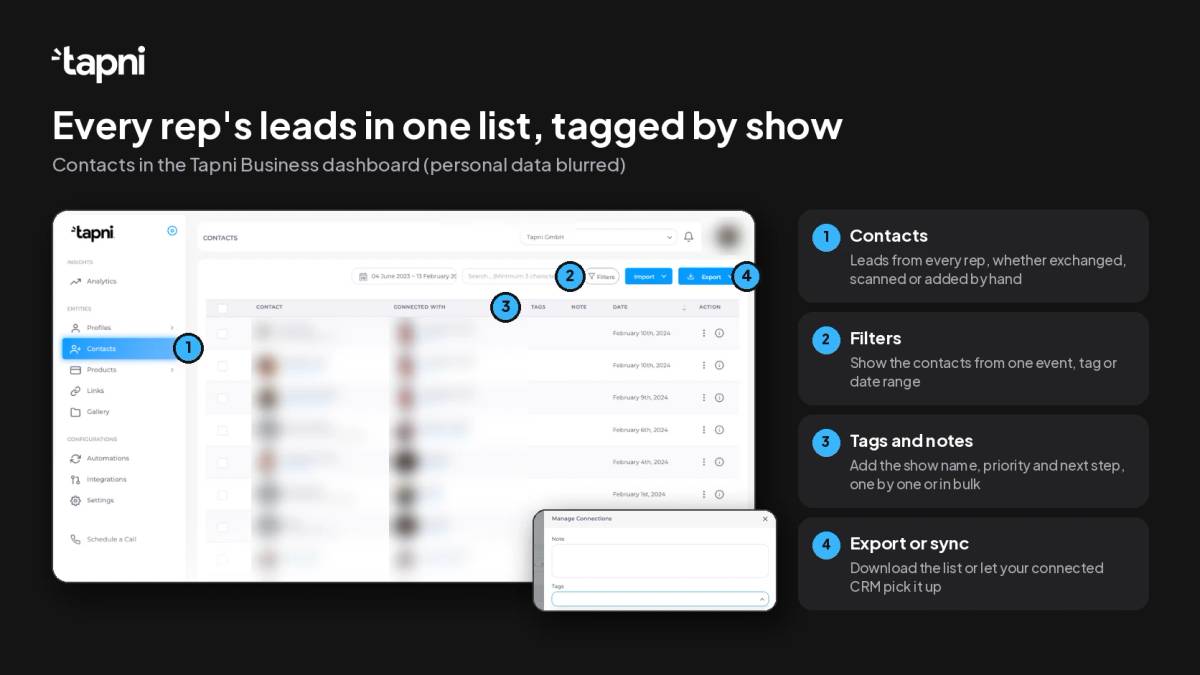
- One list, synced to your CRM. Leads from every rep appear in the dashboard, where you can filter contacts by event and tag them in bulk, and they sync to HubSpot, Salesforce, Pipedrive, Microsoft Dynamics and more, or export as CSV. The HubSpot integration guide shows the setup.
- Analytics. See your most active employees and each person's profile views by NFC tap, QR scan and link, with date filters and CSV/XLSX/PDF export.
To be clear about the limits: Tapni can't decrypt an organizer's encrypted badge. If you need the full registration record behind the barcode at a particular show, buy that show's license for at least one scanning device and import its lead export into your CRM alongside everything else.
A smarter setup: fewer licenses, every lead captured
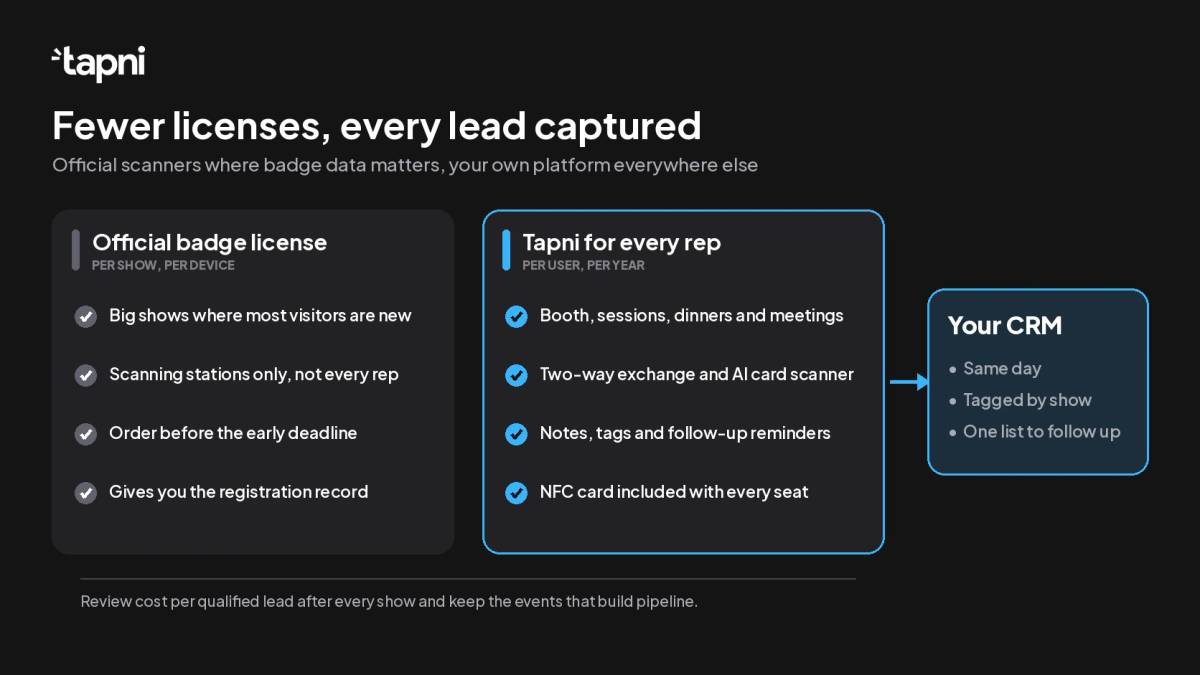
Most B2B teams get the best result from a mix: the official scanner where badge data matters, and their own platform everywhere else. Here is a simple plan you can reuse for every show.
- Decide per show whether you need badge data. At a large show where most visitors are strangers, the registration record is worth paying for. At a smaller event or a partner conference, your own lead capture may be enough.
- Buy the minimum, early. License the scanning stations, not the whole booth rota, and order before the first deadline. Compare the user package with single licenses plus extra activations, because the cheapest combination differs from show to show.
- Equip every rep with a card and a profile. Everyone on the trip can then capture leads in sessions, at dinners and in hallway conversations, where no rented scanner goes.
- Tag and qualify on the spot. Use the show name as a tag and add a one-line note on what the prospect needs.
- Get everything into the CRM the same day. Import the official lead export as soon as the vendor releases it, and let platform leads sync automatically. Our CRM integration guide explains how to set up the sync.
- Review cost per qualified lead after each show. Keep the shows that produce pipeline and cut the ones that only produce scans.
If you are still choosing a scanning tool, our roundup of event lead generation apps compares the main options.
FAQ
How much does it cost to rent a badge scanner at a trade show?
On the 2026 order forms we checked that offer one, a rented scanner cost $399 to $685 per device for one show, as of November 2026. Optional damage cover added $95 to $99 per device, and ordering after the early deadline added roughly 10% to 26%.
Is a lead retrieval app cheaper than renting a scanner?
Usually, yes. On every form that offers both, the first app license cost less than a scanner rental, and three-user packages lowered the price per user further. Renting is worth it when phones don't meet the app requirements, when you want a dedicated scanning station, or when connectivity is poor.
Can I scan trade show badges with my own app?
It depends on the show. Many organizers encrypt badges so that only the official app and equipment can read them, and outside tools need a developer or API kit, which cost $995 to $1,500 on the forms we checked. Your own app can still capture leads through two-way contact exchange and card scanning.
Do lead retrieval licenses carry over to the next show?
Plan as if they don't. Every order form we checked was for a single show, and each license activated one device. Budget lead retrieval per show and per scanning device.
Do we still need lead retrieval if our team uses digital business cards?
At shows with encrypted badges where you want the full registration data, buy at least one official license. Digital business cards cover everything else: contact exchange at the booth and beyond, card scanning, notes and CRM sync, so you can keep the number of paid licenses low.
Spend less on scanners, keep every lead
Badge scanning fees are a per-show cost you can shrink. Leads that never reach your CRM are a cost you can't recover. If you want to see how Tapni gives every rep a branded NFC card, captures leads at and away from the booth, and syncs them to your CRM, visit Tapni for Business or book a 30-minute demo with our team.